

NO 1
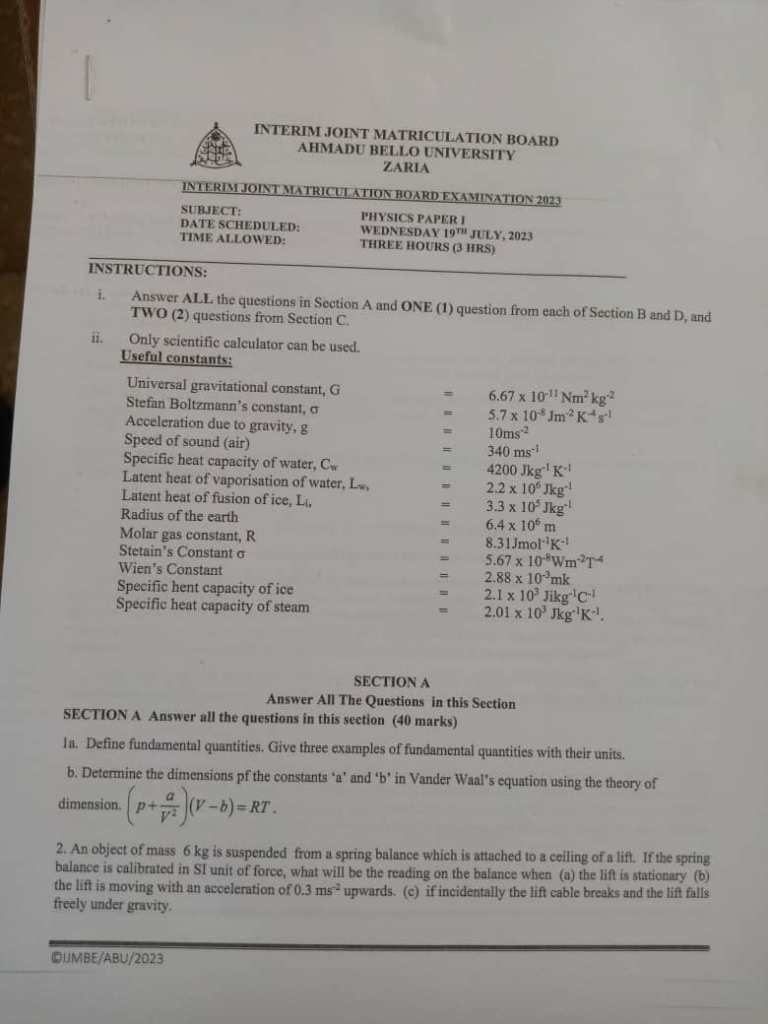
Fundamental quantities, also known as base quantities or fundamental physical quantities, are the basic measurable properties in a system of measurement. These quantities cannot be defined in terms of other quantities and serve as the foundation for deriving other derived quantities.
Here are three examples of fundamental quantities along with their units in the International System of Units (SI):
1. Length: The fundamental quantity representing the extent of a one-dimensional space.
Unit: Meter (m)
2. Mass: The fundamental quantity representing the amount of matter in an object.
Unit: Kilogram (kg)
3. Time: The fundamental quantity representing the duration or sequence of events.
Unit: Second (s)
It’s worth noting that the selection of fundamental quantities may vary depending on the system of measurement being used. The SI system is the most widely used international system and forms the basis for scientific and technical measurements.
NO 2
(a) When the lift is stationary, the reading on the spring balance will be equal to the weight of the object, which is the force exerted by gravity on the object.
The weight (force due to gravity) can be calculated using the formula:
Weight = mass * acceleration due to gravity
In SI units, the acceleration due to gravity is approximately 9.8 m/s².
Weight = 6 kg * 9.8 m/s² = 58.8 N
Therefore, the reading on the spring balance when the lift is stationary will be 58.8 Newtons.
(b) When the lift is moving with an acceleration of 0.3 m/s² upwards, we need to consider the additional force acting on the object due to the lift’s acceleration.
The net force acting on the object in this case will be the sum of its weight (force due to gravity) and the force caused by the lift’s acceleration.
Net force = Weight + Force due to acceleration
Weight = 6 kg * 9.8 m/s² = 58.8 N
Force due to acceleration = mass * acceleration
Force due to acceleration = 6 kg * 0.3 m/s² = 1.8 N
Net force = 58.8 N + 1.8 N = 60.6 N
Therefore, the reading on the spring balance when the lift is moving upwards with an acceleration of 0.3 m/s² will be 60.6 Newtons.
(c) If the lift cable breaks and the lift falls freely under gravity, the object will experience weightlessness or zero apparent weight. This is because both the object and the spring balance will fall with the same acceleration due to gravity.
In this scenario, the reading on the spring balance will be zero Newtons since there is no upward force acting on the object.
Please note that this assumes ideal conditions and neglects any air resistance or other external forces that might affect the actual motion of the falling lift.
NO 5
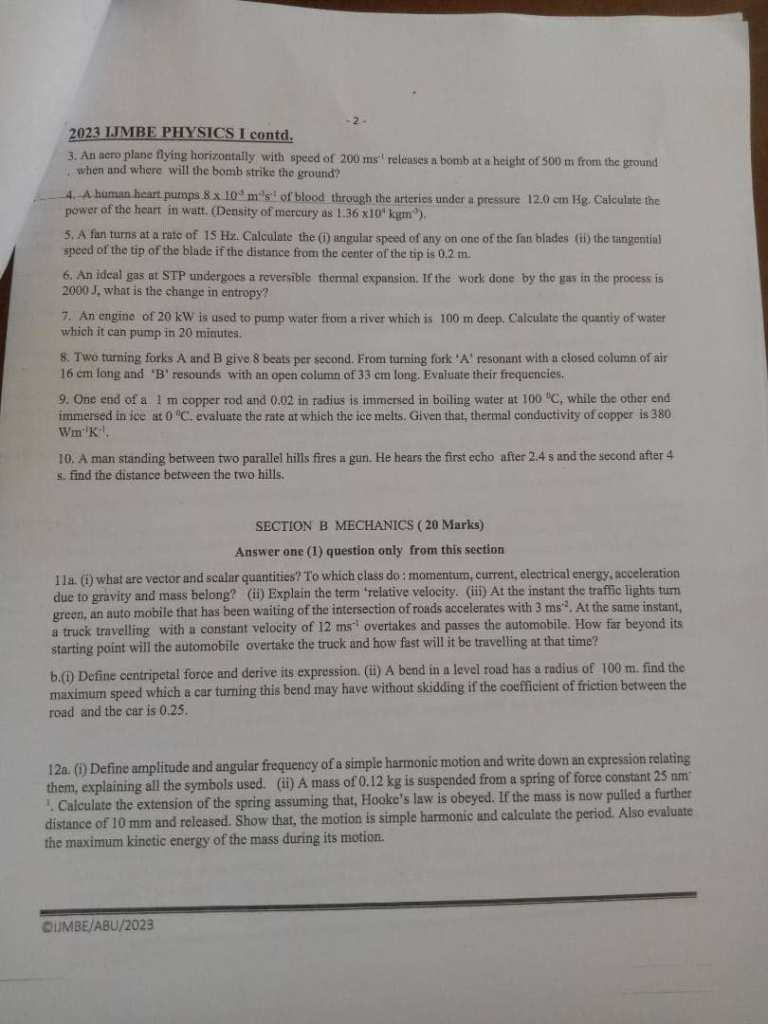
(i) The angular speed of one of the fan blades can be calculated using the formula:
Angular speed = 2π * Frequency
Here, the frequency is given as 15 Hz:
Angular speed = 2π * 15
Angular speed ≈ 94.25 radians/second
(ii) The tangential speed of the tip of the blade can be calculated using the formula:
Tangential speed = Radius * Angular speed
Given that the distance from the center to the tip of the blade is 0.2 m:
Tangential speed = 0.2 * 94.25
Tangential speed ≈ 18.85 m/s
NO 7
The quantity of water pumped by an engine can be calculated using the formula:
Quantity of water = Power * Time / (Density * g * Height)
Here, the power of the engine is given as 20 kW (kilowatts), the time is 20 minutes (convert to seconds), the density of water is approximately 1000 kg/m^3, and the height is 100 m:
Power = 20 kW = 20,000 W
Time = 20 minutes = 20 * 60 seconds
Quantity of water = (20,000 * 20 * 60) / (1000 * 9.8 * 100)=24.5kg of water
NO 11
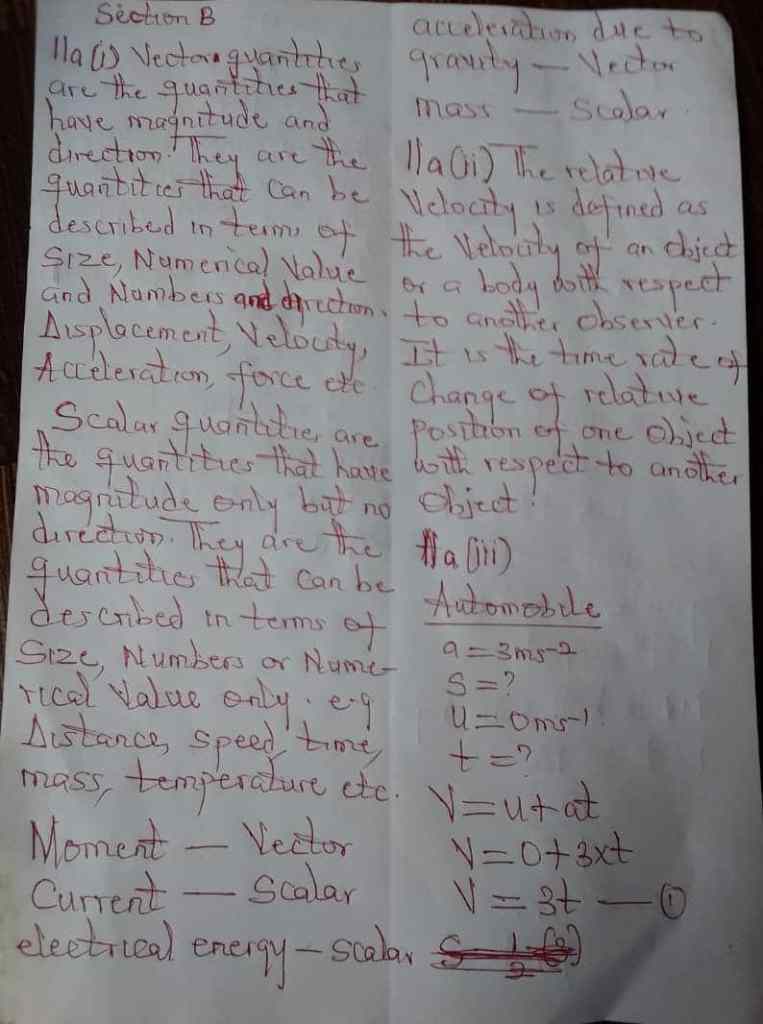
(i) Vector quantities: These are quantities that have both magnitude (size or value) and direction. They are represented by vectors, which are mathematical objects with both magnitude and direction. Examples of vector quantities include displacement, velocity, acceleration, force, and momentum.
Scalar quantities: These are quantities that have only magnitude (size or value) but no direction. They are represented by scalars, which are mathematical objects with magnitude only. Examples of scalar quantities include mass, temperature, time, distance, speed, and energy.
Now let’s determine the class of each of the given quantities:
Momentum: Momentum is a vector quantity because it has both magnitude (mass times velocity) and direction.
Current: Current is a scalar quantity because it represents the flow of charge and has magnitude only.
Electrical energy: Energy is a scalar quantity as it only has magnitude and no direction.
Acceleration due to gravity: Acceleration due to gravity is a vector quantity because it has both magnitude (9.8 m/s^2) and direction (downwards towards the center of the Earth).
Mass: Mass is a scalar quantity as it represents the amount of matter and has magnitude only.
ii) The term “relative velocity” refers to the velocity of an object as observed from the perspective of another moving object. It is the difference between the velocities of the two objects relative to a common frame of reference.
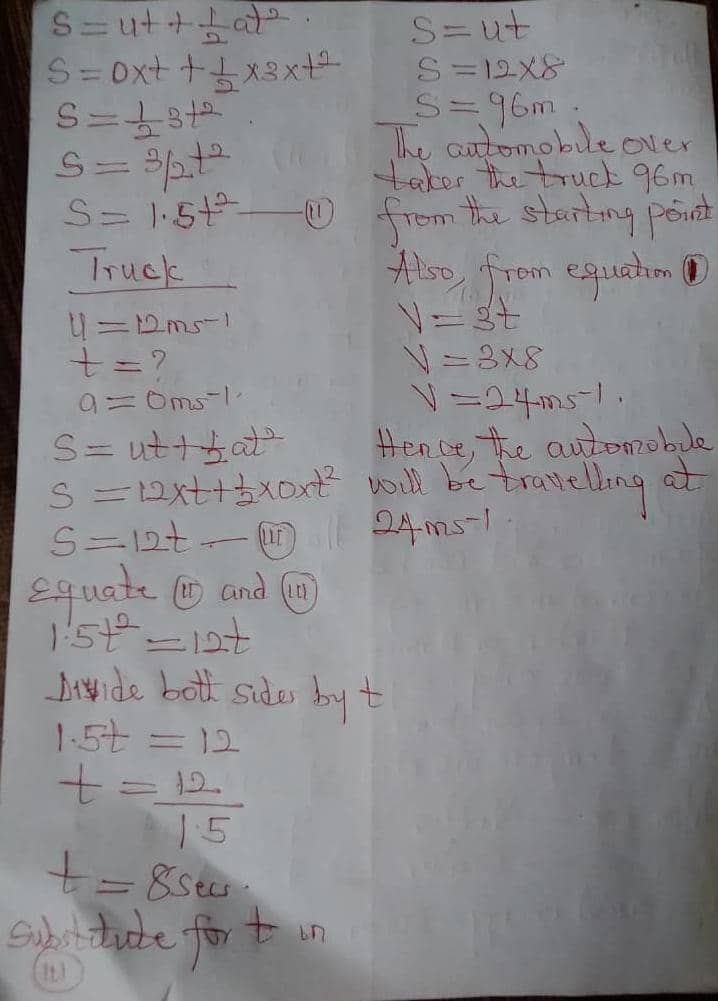
(iii) Initial velocity of the truck, V_truck = 12 m/s (constant velocity)
Acceleration of the automobile, a_auto = 3 m/s^2
Initial velocity of the automobile, u_auto = 0 m/s (at rest)
To find the distance beyond the starting point where the automobile overtakes the truck, we can use the equations of motion. The equation for the distance traveled (s) by an object with initial velocity (u), acceleration (a), and time (t) is:
s = ut + (1/2)at^2
Let’s assume the automobile overtakes the truck after time t. At that point, the distance traveled by the automobile (s_auto) will be equal to the distance traveled by the truck (s_truck). Since the truck has a constant velocity, its distance traveled is given by:
s_truck = V_truck * t
For the automobile, its initial velocity is u_auto = 0 m/s, and its acceleration is a_auto = 3 m/s^2. The distance traveled by the automobile is:
s_auto = (1/2) * a_auto * t^2
Since the two distances are equal, we can equate the expressions:
V_truck * t = (1/2) * a_auto * t^2
Simplifying the equation, we have:
2 * V_truck = a_auto * t
Substituting the given values:
2 * 12 = 3 * t
t = 8 seconds
Now we can find the distance traveled by the automobile at this time:
s_auto = (1/2) * a_auto * t^2
s_auto = (1/2) * 3 * (8)^2
s_auto = 96 meters
Therefore, the automobile will overtake the truck at a distance of 96 meters beyond its starting point. To find the final velocity of the automobile at that time, we can use the equation:
v_auto = u_auto + a_auto * t
v_auto = 0 + 3 * 8
v_auto = 24 m/s
So, the automobile will be traveling at 24 m/s when it overtakes the truck.
NO 14B
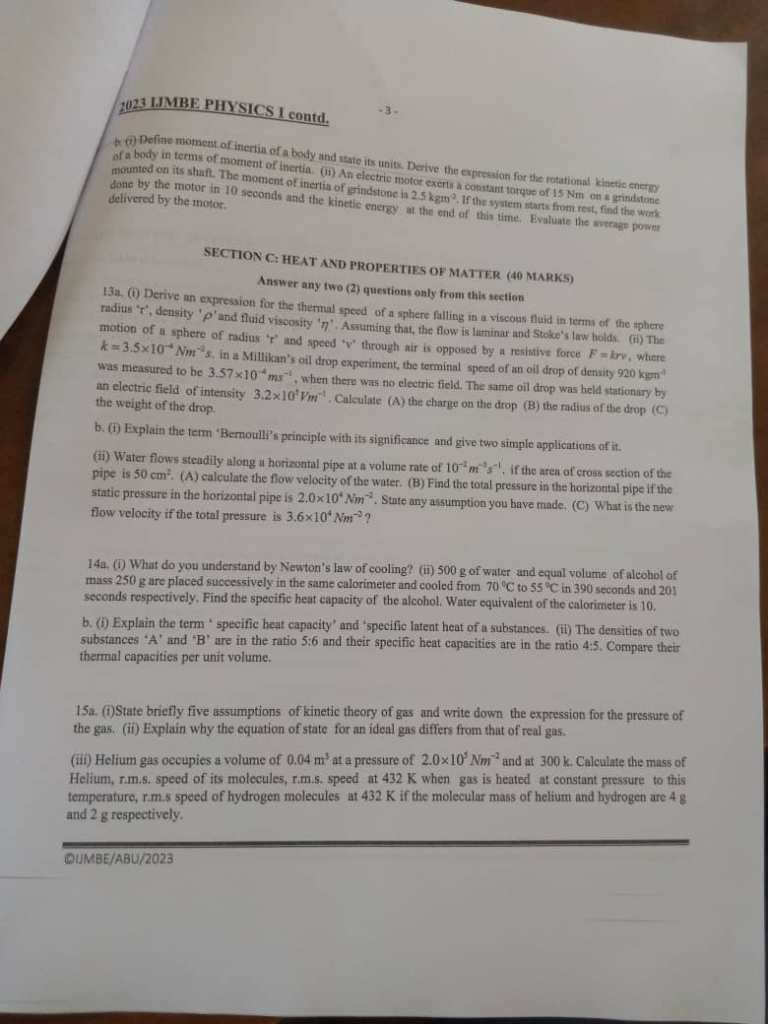
The term “specific heat capacity” refers to the amount of heat energy required to raise the temperature of a given amount of substance by a certain amount. It is the measure of how much heat energy is needed to raise the temperature of a substance per unit mass. The specific heat capacity of a substance is typically denoted by the symbol ‘c’ and is expressed in units of J/(kg·K) (joules per kilogram per Kelvin).
Specific latent heat, on the other hand, refers to the amount of heat energy required to change the state of a substance without changing its temperature. It is specifically associated with phase changes, such as melting, vaporization, or condensation. The specific latent heat of a substance is the amount of heat energy required per unit mass to undergo a phase change. It is usually denoted by the symbol ‘L’ and has units of J/kg (joules per kilogram).
Now, regarding the densities of substances ‘A’ and ‘B,’ let’s assume the density of substance ‘A’ is ‘ρA’ and the density of substance ‘B’ is ‘ρB.’ According to the given information, the ratio of the densities is 5:6. Mathematically, this can be represented as:
ρA/ρB = 5/6
This means that the density of substance ‘A’ is 5/6 times the density of substance ‘B.’ In other words, if the density of substance ‘B’ is taken as a reference, the density of substance ‘A’ is 5/6 of that reference density.
NO 17A
(I)
Temperature: The velocity of sound in air is directly proportional to the square root of the absolute temperature. This relationship is described by Newton’s formula for the speed of sound:
v = √(γ * R * T)
where:
v is the velocity of sound,
γ is the adiabatic index (approximately 1.4 for air),
R is the specific gas constant for dry air (approximately 287 J/(kg·K)),
T is the absolute temperature in Kelvin.
As temperature increases, the velocity of sound in air also increases. This is because at higher temperatures, air molecules have greater kinetic energy and vibrate more vigorously, leading to faster propagation of sound waves.
Pressure: The velocity of sound in air is not significantly affected by changes in pressure. The compressibility of air is relatively low, so variations in pressure have a minimal impact on the speed of sound.
Humidity: Humidity, or the moisture content in the air, affects the velocity of sound by altering air density. Moist air is less dense than dry air, which reduces the velocity of sound. However, the influence of humidity is relatively small compared to the effects of temperature.
(ii)
Given:
Temperature 1 (T1) = 14 °C
Pressure 1 (P1) = Normal atmospheric pressure (assuming 1 atm)
Temperature 2 (T2) = 200 °C
Pressure 2 (P2) = 3 times the normal atmospheric pressure (3 atm)
First, we need to convert the temperatures to Kelvin:
T1 = 14 °C + 273.15 = 287.15 K
T2 = 200 °C + 273.15 = 473.15 K
Using the formula mentioned earlier:
v1 = √(γ * R * T1)
Substituting the values:
v1 = √(1.4 * 287 * 287.15) ≈ 343.3 m/s
Now, to calculate the velocity at the new conditions, we need to consider the pressure change as well:
v2 = v1 * √(P2 / P1)
Substituting the values:
v2 = 343.3 m/s * √(3 / 1) = 343.3 m/s * √3 ≈ 593.8 m/s
Therefore, when the pressure is tripled and the temperature is raised to 200 °C, the velocity of sound in air would be approximately 593.8 m/s.
NO 17B
(i)
Fundamental Note:
The fundamental note is the lowest frequency produced by a vibrating object or system. It is also known as the first harmonic. When an object vibrates at its fundamental frequency, it produces a pure and distinct sound. In musical terms, the fundamental note corresponds to the pitch of a musical tone.
Overtone:
An overtone is a higher frequency produced in addition to the fundamental frequency of a vibrating object. Overtone frequencies are multiples of the fundamental frequency. The first overtone is twice the frequency of the fundamental, the second overtone is three times the frequency, and so on. Overtones contribute to the timbre or tone quality of a sound and give it richness and complexity.
Harmonic Frequencies:
Harmonic frequencies are the frequencies of the various overtones present in a vibrating system. They are integer multiples of the fundamental frequency.
(ii)
The mass of the wire can be evaluated using the formula for the frequency of a stretched wire:
f = (1/2L) * sqrt(T/μ)
Where:
f = frequency of vibration
L = length of the wire
T = tension in the wire
μ = linear mass density of the wire
Given:
Length of the wire (L) = 100 cm = 1 meter
Frequency of vibration (f) = 300 vibrations per second
Tension in the wire (T) = 10 kg
We need to solve for the linear mass density (μ).
Rearranging the formula, we get:
μ = (T^2 * (2L)^2) / (4π^2 * f^2)
Substituting the given values:
μ = (10^2 * (2 * 1)^2) / (4 * π^2 * 300^2)
Calculating this expression will give us the linear mass density (μ) of the wire.
iii)
The two sources must have the same frequency. If they have different frequencies, a stationary wave cannot be formed.
The two sources must have the same amplitude (or at least approximately the same). If one source has a significantly higher amplitude than the other, the wave pattern will be distorted and a clear stationary wave will not form.
The two sources should be coherent, meaning that they maintain a constant phase relationship. This ensures that the crests and troughs of the waves from both sources align properly to create a stationary wave pattern.
NO 18A
I) The Doppler effect is a phenomenon observed in waves, such as sound or light, when there is relative motion between the source of the waves and the observer. It describes the change in frequency or wavelength of the waves as a result of this motion.
(ii) f’ = f * (v + v₀) / (v + vᵢ)
where:
f’ is the observed frequency
f is the emitted frequency
v is the velocity of sound in the medium (assumed to be constant)
v₀ is the velocity of the observer relative to the medium (stationary in this case)
vᵢ is the velocity of the source relative to the medium (2 m/s in this case)
Assuming the velocity of sound in air is approximately 343 m/s (at room temperature), we can substitute the given values into the formula:
f’ = 600 Hz * (343 m/s + 0 m/s) / (343 m/s – 2 m/s)
Simplifying the equation:
f’ = 600 Hz * (343 m/s) / (341 m/s)
f’ = 603.5 Hz
Therefore, the apparent shift in frequency is approximately 603.5 Hz.
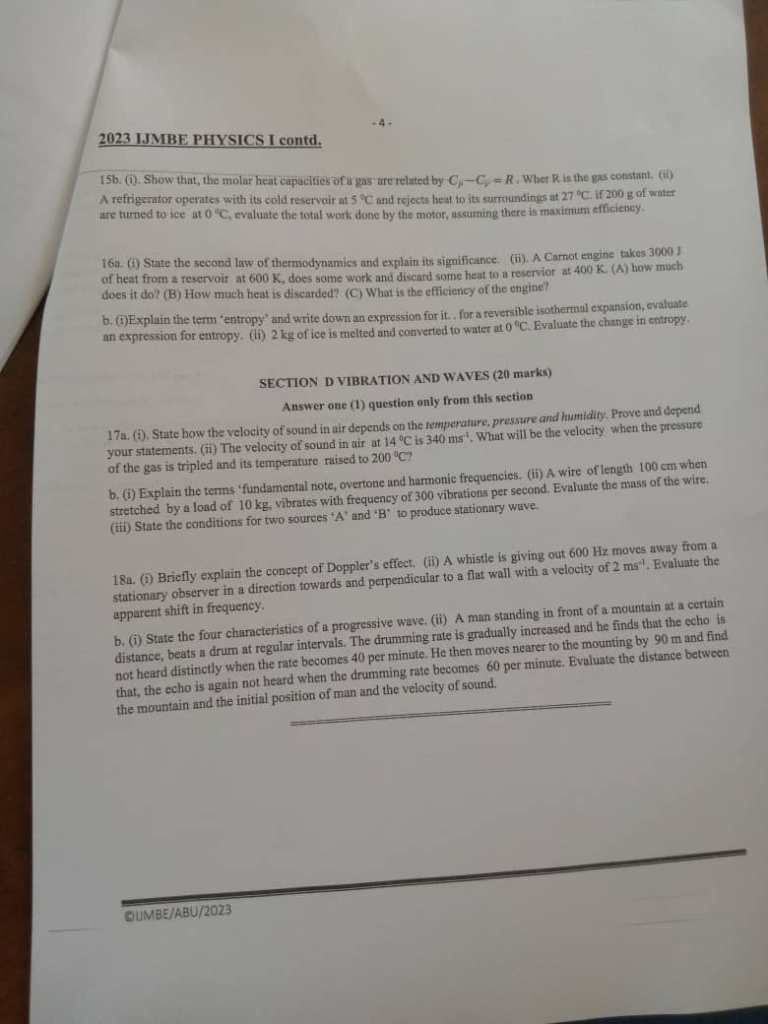
2023 IJMB PHYSICS I QUESTIONS ⤵️
Contact Us Only On WhatsApp : 08167972482
Click Here To Join Our WhatsApp Group
 BEST EXAM PORTAL 1