

NO (1)
Objectives in an organization are specific goals or targets that the organization aims to achieve. Objectives provide direction and purpose for the organization’s activities and help in measuring its success. Major goals an organization may pursue at the same time are:
(i) Profit Maximization: One of the primary objectives for most organizations is to maximize profitability. This involves increasing revenues reducing costs and optimizing resource allocation to generate higher profits for the organization.
(ii) Market Share Expansion: Organizations often strive to increase their market share aiming to capture a larger portion of the target market compared to their competitors. This objective typically involves product differentiation aggressive marketing strategies and customer retention efforts.
(iii) Customer Satisfaction: Another important objective is to provide high-quality products or services that meet or exceed customer expectations. Organizations may focus on improving product features enhancing customer service and implementing effective feedback systems to ensure high levels of customer satisfaction.
(iv) Innovation and Growth: Many organizations prioritize innovation and growth as key objectives. This involves developing new products entering new markets and continually improving processes and technologies to remain competitive and expand their business.
(v) Corporate Social Responsibility: Organizations are increasingly recognizing the importance of social and environmental responsibility. They may set objectives related to sustainability ethical business practices community involvement and minimizing their impact on the environment.
NO (2)
Authority is the power or right to give orders make decisions and enforce obedience. It is a crucial element in any organization as it establishes the hierarchy and structure necessary for efficient functioning. Authority can be vested in individuals or positions within the organization and it is often accompanied by the responsibility to carry out certain tasks or duties.
One aspect of authority is the concept of delegation. Delegation is the transfer of authority from one individual or position to another. It is a fundamental process in organizations to distribute workload foster teamwork and provide opportunities for growth and development. However, there are instances where non-delegation of authority by a position holder is necessary and justified.
One reason for the non-delegation of authority is when the task or decision at hand requires specialized knowledge or expertise that the position holder possesses. For example, a CEO of a company may choose not to delegate the authority to make certain strategic decisions because they have the necessary experience and knowledge to make those decisions effectively. In this case, the non-delegation of authority ensures that decisions are made by someone with the appropriate skill set minimizing the risk of errors or misjudgments.
Another reason for non-delegation of authority is when the task or decision carries significant risks or consequences. This could be the case in situations where the decision may have legal implications that impact financial stability or affect the reputation of the organization. In such instances, the position holder may choose not to delegate authority to ensure that they have full control and accountability for the outcome taking into consideration the potential consequences.
Additionally, non-delegation of authority may occur when the position holder needs to maintain control over certain activities that are critical to the overall success of the organization. For example, a manager may choose not to delegate the authority to hire or fire employees as they want to be directly involved in the process to ensure that the right people are selected for important positions. By retaining authority over specific tasks the position holder can maintain a level of quality and consistency.
Lastly, non-delegation of authority may be necessary when a position holder needs to preserve and exercise their leadership and management capabilities. By maintaining authority over certain decisions or tasks the position holder can demonstrate their ability to lead and provide direction to the organization. It also allows them to establish their presence and authority within the organization reinforcing the hierarchical structure.
In conclusion, while delegation of authority is crucial for the effective functioning and growth of an organization there are valid reasons for non-delegation. These include the need for specialized knowledge the existence of significant risks or consequences the desire to maintain control over critical activities and the preservation of leadership authority. Non-delegation of authority allows position holders to exercise their expertise take accountability ensure quality and demonstrate leadership capabilities.
NO 5
Roles in an organization refer to the positions or responsibilities assigned to individuals. These roles define the functions and tasks that individuals are expected to perform within the organization’s structure. In this context, managerial roles are the specific roles that managers play in an organization to ensure effective leadership and coordination.
There are various types of managerial roles that managers perform within an organization. These roles can be broadly categorized into three main categories: interpersonal roles, informational roles, and decisional roles.
Interpersonal Roles:
Interpersonal roles involve interaction with people both inside and outside the organization. These roles are primarily concerned with building and maintaining relationships. There are three main interpersonal roles:
(i). Figurehead Role: Managers often act as symbolic representatives of their organizations. They perform ceremonial duties, such as attending events, signing documents, and representing the organization in public.
(ii). Leader Role: Managers act as leaders by providing guidance, support, and direction to their subordinates. They motivate employees, set goals, delegate tasks, and ensure that work is being done effectively.
3. Liaison Role: Managers act as liaisons between different departments or individuals within the organization. They facilitate communication and collaboration between various stakeholders to ensure smooth operations.
Informational Roles:
Informational roles involve collecting, processing, and disseminating information within the organization. These roles are essential for effective decision-making and communication. There are three main informational roles:
(i). Monitor Role: Managers monitor internal and external environments to gather relevant information about the organization’s performance, market trends, and competitors. This information helps them make informed decisions.
(ii) Disseminator Role: Managers share information with their subordinates and other stakeholders within the organization. They communicate goals, policies, strategies, and other relevant information to ensure everyone is on the same page.
(iii). Spokesperson Role: Managers act as spokespeople for their organizations by representing them in external communications. They communicate with stakeholders such as customers, suppliers, and the media to promote the organization’s image and interests.
Decisional Roles:
Decisional roles involve making decisions and resolving problems within the organization. These roles require managers to analyze situations, evaluate alternatives, and take appropriate actions. There are four main decisional roles:
(i). Entrepreneur Role: Managers act as entrepreneurs by identifying new opportunities and taking risks to improve the organization’s performance. They initiate innovative projects, explore new markets, and foster a culture of creativity.
(ii). Disturbance Handler Role: Managers handle conflicts, crises, and other disturbances that arise within the organization. They address problems promptly, make tough decisions, and ensure that disruptions are minimized.
(iii) Resource Allocator Role: Managers allocate resources such as budget, manpower, and equipment to different departments or projects based on organizational priorities. They ensure that resources are distributed effectively to achieve goals.
(iv). Negotiator Role: Managers negotiate with external parties such as suppliers, customers, or other organizations to establish mutually beneficial agreements. They represent the organization’s interests and strive for favorable outcomes.
In conclusion, managerial roles in an organization encompass a range of responsibilities and tasks. Interpersonal roles involve building relationships, informational roles focus on information management, and decisional roles revolve around decision-making and problem-solving. Effective managers understand these roles and balance them to ensure organizational success.
NO (6)
(i) Communication: Good leaders possess strong communication skills to articulate their vision, expectations, and goals clearly. They can also actively listen to their team members’ concerns and ideas.
(ii) Emotional Intelligence: Leaders with high emotional intelligence can understand and manage their own emotions effectively, as well as empathize with others. This skill enables them to build strong relationships and foster a positive work environment.
(iii) Decision-Making: Effective leaders are skilled decision-makers, able to analyze information, consider various options, and make informed choices that align with the organization’s objectives.
(iv) Problem-Solving: Leaders should be adept at identifying and solving problems that arise within the organization or team. They can navigate challenges with creativity and strategic thinking.
(v) Adaptability: Leadership often involves dealing with uncertainty and change. Leaders who are adaptable can quickly adjust their strategies and approaches to address evolving situations.
(vi) Delegation: Effective leaders know how to delegate tasks to team members based on their strengths and capabilities, optimizing productivity and efficiency.
(vii) Motivation: Leaders should inspire and motivate their teams to achieve their best performance and stay committed to the organization’s mission.
(viii) Integrity: Leaders with strong moral and ethical principles gain trust and respect from their team members, which fosters a positive work environment and promotes loyalty.
(ix) Strategic Vision: A clear vision of where the organization is heading and how to get there is a crucial skill for leaders. They should be able to set long-term goals and devise strategies to achieve them.
(x) Conflict Resolution: Leaders need to handle conflicts that arise within their team or between team members in a constructive and fair manner.
The trait approach to leadership is based on the idea that leaders possess certain innate traits or characteristics that make them effective. The key idea of the trait approach is that leaders are born, not made. Some of the traits that have been identified as important for effective leadership include intelligence, self-confidence, determination, integrity, and sociability.
The trait approach to leadership has been criticized for oversimplifying the complex nature of leadership. It ignores the role of situational factors and the importance of skills and behaviors that can be learned and developed over time. Despite these criticisms, the trait approach has contributed to our understanding of leadership and has helped identify some of the key traits that are associated with effective leadership.
NO (3)
Roles refer to the specific functions and responsibilities that individuals hold within an organization. These roles are essential for the smooth operation and coordination of activities to achieve the organization’s goals and objectives. In a hierarchical structure, roles are often associated with different levels of authority and decision-making responsibilities.
In an organization, there are three main types of managerial roles:
(i) Interpersonal Roles: These are roles that involve managing relationships with other people. There are three subcategories of interpersonal roles:
– Figurehead: The manager represents the organization in a formal capacity.
– Leader: The manager is responsible for leading and motivating employees.
– Liaison: The manager maintains relationships with external stakeholders.
(ii) Informational Roles: These are roles that involve the processing and distribution of information. There are three subcategories of informational roles:
– Monitor: The manager gathers information from both internal and external sources.
– Disseminator: The manager shares information with employees and other stakeholders.
– Spokesperson: The manager communicates information about the organization to external stakeholders.
(iii) Decisional Roles: These are roles that involve making decisions that affect the organization. There are four subcategories of decisional roles:
– Entrepreneur: The manager identifies and pursues new opportunities for the organization.
– Disturbance Handler: The manager addresses problems and conflicts within the organization.
– Resource Allocator: The manager decides how resources should be allocated within the organization.
– Negotiator: The manager negotiates with other organizations or individuals on behalf of the organization.
In summary, the various types of managerial roles in an organization are interpersonal roles, informational roles, and decisional roles. These roles are essential to the success of an organization, and managers must be able to perform them effectively to achieve organizational goals.
NO (8)
Business environment are the external and internal factors that affect the operations and functioning of a business organization. It includes various factors such as customers suppliers competitors technology government regulations socio-economic factors cultural factors etc. The differences between the internal and external environment of a business organization are:
(i) Control: The internal environment is directly controlled and managed by the organization while the external environment is beyond the organization’s control.
(ii) Influence: The internal environment has a direct and immediate influence on the organization’s operations and decisions. In contrast the external environment exerts an indirect and more long-term influence on the organization.
(iii) Changeability: The internal environment is relatively more changeable and can be altered by the organization through its decisions and actions. The external environment is less changeable and can be influenced only to a limited extent by the organization.
(iv) Resources: The internal environment consists of the organization’s resources capabilities and competencies which can be leveraged to gain a competitive advantage. The external environment provides opportunities and threats that the organization needs to assess and respond to using its internal resources.
(v) Adaptability: The internal environment can be more easily adapted and aligned to the organization’s goals and strategies. In contrast the external environment requires the organization to be flexible and responsive in order to adapt to the changing external conditions.
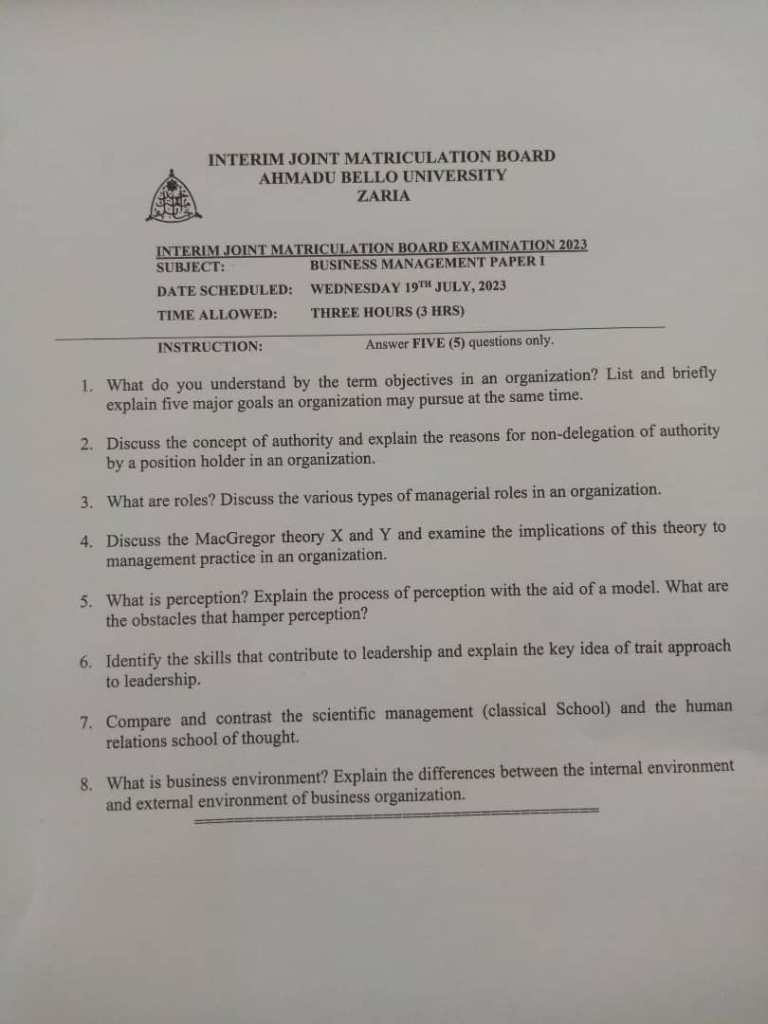
2023 IJMB BUSINESS MANAGEMENT QUESTIONS ⤵️
Contact Us Only On WhatsApp :08167972482
Click Here To Join Our WhatsApp Group
 BEST EXAM PORTAL 1