
(1a)
The subject matter of this poem is a personal relationship and a decision that the poet has to make.
(1b)
The dilemma that the poet found himself in was whether to leave or stay with the other person. The poet is conflicted and unsure about the decision. However the doubts are dispelled when the other person shows their love and support by lifting the “lamp of love.” This action helps the poet see clearly the road they should take and they choose to stay with the other person.
(1c)
The poet chose the title “The Mesh” because it represents the complexity and entanglement of the poet’s emotions and thoughts. The cross-roads symbolize a decision point and the mesh suggests a web of conflicting choices and possibilities. The title ties in with the poem itself as the poet is trapped in the mesh of their doubts and uncertainties until the other person’s love helps to untangle and clarify their path.
(1d)
(i) Metaphor: The “lamp of love” is a metaphor that represents the other person’s love and guidance.
(ii) Imagery: The poet creates imagery with the phrase “darkness of my doubts” and “saw in your face”.
(iii) Alliteration: The repetition of sounds in “linger over the choice”.
(iv) Symbolism: The cross-roads symbolize a decision point in the poet’s life.
(1e)
The form of this poem seems to be free verse. It doesn’t follow a specific rhyme scheme or meter. Instead it focuses on the flow of thoughts and emotions.
(1f)
What strikes me most about the first and last lines of the poem is the sense of uncertainty and finality. The first line implies a decision must be made while the last line suggests that the poet has made their choice and will be moving forward on the road they have chosen. It gives a sense of resolution and determination.
(4)
Edward Braithwaite’s “The Arrivants: A new world trilogy” explores the theme of roots and identity in a deep and profound manner. In “Rights of Passage” the first part of the trilogy Braithwaite delves into his personal experiences as a Caribbean immigrant living in England as well as the collective experiences of the African diaspora.
Braithwaite’s search for roots and identity is evident in the poem “Stony Coral: The Education of a Freshman.” Here the persona narrates the struggles and challenges faced by Caribbean immigrants in a foreign land. The poem portrays the protagonist’s longing for a sense of belonging and acceptance as he grapples with issues of race education and cultural assimilation. The persona’s journey through education is not just a quest for knowledge but also a means of understanding his own identity. It is through education that he hopes to find his place in society to reclaim his roots and to assert his identity as a Caribbean immigrant.
Similarly in “The Emigrants Braithwaite explores the theme of identity through the experiences of Caribbean immigrants living in England. The poem highlights the challenges faced by these immigrants as they navigate through a society that is often hostile and unwelcoming. The persona in the poem reflects on the loss of cultural identity and the struggle to maintain a connection to their Caribbean roots. The poem conveys a sense of displacement and longing for a homeland that is far away as well as the need to preserve and celebrate their cultural heritage amidst the pressures of assimilation.
Throughout “Rights of Passage Braithwaite’s search for roots and identity is constant. He delves into his personal journey as well as the broader experiences of the African diaspora making a powerful statement about the importance of understanding one’s roots and embracing an identity that is true to oneself. Braithwaite’s exploration of these themes resonates deeply with the reader as he invites us to question our own sense of identity and the roots that shape us.
In conclusion Edward Braithwaite’s “The Arrivants: A new world trilogy” presents a deep search for roots and identity in the poems included in “Rights of Passage.” Through his own experiences as a Caribbean immigrant and the collective experiences of the African diaspora Braithwaite brings to light the struggles and challenges faced by those in search of a sense of belonging and self.
(5)
Braithwaite’s The Arrivants is a fascinating work of literature that showcases a unique style. The trilogy is written in a poetic form with each poem consisting of a sequence of verses filled with vivid imagery and vibrant language.
One of the notable stylistic features of Braithwaite’s work is his use of a distinct narrative voice. The poems are often narrated in a first-person perspective allowing the reader to connect intimately with the experiences and emotions of the characters. This personal touch brings an authenticity and depth to the poems making the reader feel like they are right there experiencing the story alongside the protagonists.
Braithwaite’s use of imagery is also remarkable. He masterfully paints a picture with his words using rich sensory details to transport the reader to different times and places. His descriptions are so vivid that they evoke all the senses making the reader feel as if they can taste the salt in the air or feel the warmth of the sun on their skin.
The language in The Arrivants is both lyrical and evocative. Braithwaite’s choice of words is carefully crafted with a rhythm and flow that adds musicality to the poems. He uses a variety of poetic devices such as metaphors similes and personification to enhance the meaning and impact of his words.
Another noteworthy aspect of Braithwaite’s style is his exploration of themes of identity belonging and colonialism. The trilogy delves into the experiences of Caribbean immigrants in the UK addressing the challenges they face in navigating a new culture while trying to retain their own heritage. Braithwaite skillfully intertwines personal stories with broader historical contexts creating a multi-layered narrative that engages the reader intellectually and emotionally.
Overall Braithwaite’s style in The Arrivants is a seamless blend of poetry storytelling and social commentary. His vivid imagery powerful language and nuanced exploration of themes make the trilogy a captivating and thought-provoking read. Braithwaite’s unique style truly brings the stories of the characters to life leaving a lasting impression on the reader’s mind.
SECTION C
(7)
Movement 1: Awareness and Critique of Modern Society:
In the first movement of Osundare’s collection there is a clear emphasis on the poet’s awareness and critique of modern society. This can be seen in the poem “Generation Gap where Osundare explores the differences between the older and younger generations. He highlights how the younger generation seems to be disconnected from their roots and heritage as they are consumed by materialism and Western influences. The poem serves as a critique of the loss of cultural identity and the erosion of traditional values in modern society.
Another poem that exemplifies this movement is “Petrospect where Osundare comments on the destructive impact of oil exploration on the environment and the people living in the Niger Delta region of Nigeria. The poet exposes the greed and corruption of those in power who exploit the land and its resources without considering the long-term consequences. Through his powerful imagery and vivid descriptions Osundare draws attention to the plight of the people and the devastation caused by the exploitation of natural resources.
Movement 2: A Call for Social Justice and Political Activism:
The second movement in The eye of the earth reflects Osundare’s call for social justice and political activism. In the poem “Rendering unto Caesar Osundare speaks out against political oppression and the abuse of power. He challenges the reader to question authority and to stand up for justice in the face of oppression. The poem serves as a rallying call for resistance and activism against authoritarian regimes.
Similarly in the poem “The Eye of the Earth Osundare advocates for environmental protection and conservation. He urges humanity to recognize the interconnectedness of all living beings and to take responsibility for preserving the earth’s resources. The poem serves as a reminder of the urgent need to address climate change and to adopt sustainable practices.
Movement 3: Celebration of African Culture and Identity:
The final movement in Osundare’s collection is a celebration of African culture and identity. In the poem “Baba Oko Osundare pays homage to his roots and the wisdom passed down from generations before. Through the use of vivid imagery and the incorporation of traditional folklore he showcases the richness and resilience of African culture.
In the poem “Strong Feet Osundare celebrates the strength and endurance of African women. He portrays their ability to overcome adversity and their resilience in the face of oppression. The poem serves as a tribute to the strong and powerful women who have played a crucial role in shaping African society.
Overall Osundare’s The eye of the earth moves through a progression of themes and messages. It begins with an awareness and critique of modern society then transitions into a call for social justice and political activism and finally concludes with a celebration of African culture and identity. Through his poetry Osundare encourages his readers to be mindful of their actions to strive for a more just society and to embrace their cultural heritage.
(8)
Firstly the letter form allowed for a private and confidential means of communication. As Brutus was part of a conspiracy against Julius Caesar it was crucial for him to maintain secrecy and avoid detection. By writing letters he could effectively convey his thoughts and plans without arousing suspicion or exposing the conspiracy to potential informants or spies.
Secondly the letter form provided Brutus with the opportunity to carefully articulate his reasoning and intentions. As a highly respected and educated individual Brutus wanted to ensure that his message was clear and persuasive. By writing letters he could take the time to structure his arguments and select his words carefully allowing for a more thoughtful and impactful communication of his ideas. This was especially important considering the gravity of his decision to betray Caesar as he needed to convince his fellow conspirators and potential sympathizers of the justness of their cause.
Furthermore the letter form allowed Brutus to reach a wider audience and disseminate his message more effectively. By sending letters to trusted allies and associates he could share his perspective and rally support for their cause. Letters could be shared copied and circulated allowing for broader exposure and engagement with his ideas. This was key in building a united front against Caesar and ensuring that others were aware of the conspiracy’s motivations and goals.
Additionally the emotional impact of letters cannot be underestimated. Through the artful deployment of rhetoric and persuasive language Brutus could appeal to the emotions of his readers fostering a sense of sympathy loyalty and understanding. The personal nature of letters allowed for a stronger connection to be established making it more likely for recipients to align themselves with his cause.
In conclusion Brutus’ use of the letter form to communicate his message was justified due to its ability to maintain confidentiality provide a platform for careful and persuasive communication reach a wider audience and elicit emotional responses. These factors were essential in advancing the conspirators’ objectives and garnering support for their cause.
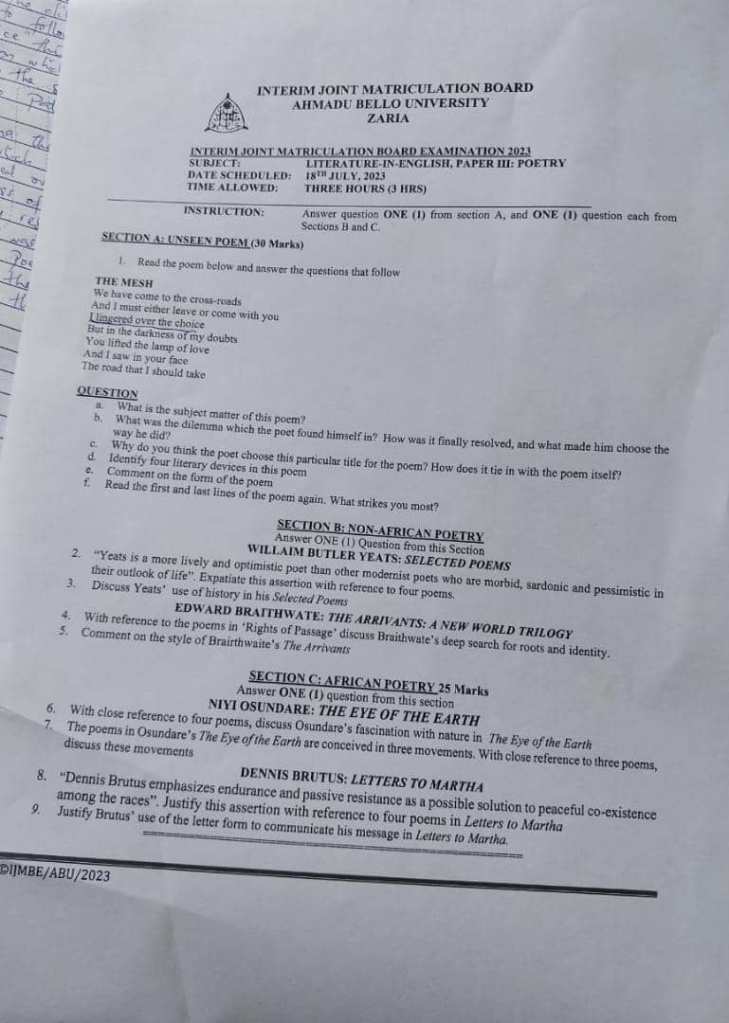
2023 IJMB LITERATURE III QUESTIONS ⤵️
Contact Us Only On WhatsApp : 08167972482
Click Here To Join Our WhatsApp Group
 BEST EXAM PORTAL 1