

WAEC 2023 CIVIC EDUCATION
👇🏻👇🏻👇🏻👇🏻💯💯💯
CIVIC-OBJ
1-10: ACCABADDCD
11-20: CADBADABCD
21-30: DADADCCADB
31-40: AADDACCDBB
41-50: BDCBCDDAAD
COMPLETED
INSTRUCTIONS
ANSWER FOUR QUESTIONS ONLY
SECTION A – 1
SECTION B – 1
SECTION C – 1
_AND ANY QUESTION FROM EITHER SECTION A,B&C TO MAKE IT FOUR QUESTIONS TOTAL._
1. (a) Five values of civic education are:
1. Democratic participation: Civic education promotes the value of active participation in democratic processes such as voting, engaging in public debates, and joining community organizations. It emphasizes the importance of citizens’ voices being heard and their active involvement in decision-making.
2. Respect for diversity: Civic education fosters an appreciation for diverse cultures, religions, and perspectives. It encourages respect for individual and group differences, promoting inclusivity and tolerance in society.
3. Social justice: Civic education instills a sense of fairness and equality. It teaches about human rights, social responsibilities, and the need to address injustices. It empowers individuals to stand up against discrimination, inequality, and oppression.
4. Ethical behavior: Civic education emphasizes the importance of ethical conduct and responsible citizenship. It promotes honesty, integrity, empathy, and accountability in personal and public life.
5. Critical thinking: Civic education cultivates critical thinking skills, enabling individuals to analyze and evaluate information, make informed decisions, and participate actively in public discourse. It encourages citizens to question, research, and seek multiple perspectives on societal issues.
(b) Citizenship education contributes to nation-building in the following ways:
1. Nationhood and identity: Citizenship education helps individuals develop a sense of national identity, fostering a shared understanding of values, history, and cultural heritage. It strengthens the bond between citizens and their nation, promoting unity and social cohesion.
2. Active citizenship: Civic education empowers individuals to actively participate in civic life, including community development projects, volunteer work, and public service. It encourages citizens to take ownership of their communities and contribute to their improvement.
3. Democratic governance: Citizenship education promotes an understanding of democratic principles, processes, and institutions. It equips individuals with knowledge about their rights and responsibilities as citizens, preparing them to engage in democratic decision-making and hold elected representatives accountable.
4. Social responsibility: Civic education instills a sense of social responsibility, emphasizing the importance of contributing positively to society. It encourages citizens to be aware of societal issues, such as poverty, inequality, and environmental challenges, and motivates them to work towards their resolution.
5. Peaceful coexistence: Citizenship education promotes respect, understanding, and dialogue among individuals from different backgrounds. It equips citizens with skills to resolve conflicts peacefully, fostering social harmony and reducing tensions within the nation.
2. (a) Three factors that determine the legitimacy of a constituted authority in society are:
1. Legal framework: The authority’s legitimacy is determined by its conformity to the legal and constitutional framework of the country. If the authority derives its power from a legitimate source, such as a constitution or established laws, it enhances its legitimacy in the eyes of the society.
2. Consent of the governed: The consent and acceptance of the governed play a crucial role in determining the legitimacy of an authority. When people willingly recognize and support the authority, considering it a legitimate representative of their interests, its legitimacy is strengthened.
3. Performance and effectiveness: The legitimacy of an authority can be influenced by its ability to effectively address societal needs, provide public services, and maintain law and order. If the authority is perceived as competent and responsive, it gains greater legitimacy in the eyes of the society.
(b) Six factors that facilitate citizens’ obedience to constituted authority in Nigeria are:
1. Trust in leadership: When citizens trust their leaders and have confidence in their ability to govern and make decisions in the best interest of the nation, they are more likely to obey constituted authority.
2. Shared values and norms: When there is a common understanding and acceptance of societal values and norms, citizens are more inclined to adhere to constituted authority that upholds and enforces those values and norms.
3. Effective communication: When authorities effectively communicate their policies, decisions, and intentions to the public
2. (a)
:
(i) Constitutional authority: The extent to which the authority is based on the constitution of the country.
(ii) Democratic legitimacy: The extent to which the authority is elected or appointed through a democratic process.
(iii) Moral legitimacy: The extent to which the authority is supported by societal values and moral principles.
(b) Six factors that facilitate citizens’ obedience to constituted authority in Nigeria include:
(i) Socialization: Citizens are socialized to obey constituted authority through family, religion, and education.
(ii) Fear of punishment: Citizens obey constituted authority to avoid punishment or sanctions.
(iii) Legitimacy: Citizens obey constituted authority when they perceive it to be legitimate and fair.
(iv) Trust: Citizens obey constituted authority when they trust it to act in their best interests and to uphold the rule of law.
(v) Rewards: Citizens may obey constituted authority when they receive rewards, such as access to services or economic opportunities.
(vi) Coercion: Citizens may be coerced to obey constituted authority through the use of force or threats.
3. (a) Inter-communal relationships refer to the interactions between communities and groups of people from different ethnic, religious, or cultural backgrounds.
(b) :
(i) Promotion of social harmony: Inter-communal relationships encourage dialogue, understanding, and cooperation between different groups, leading to social harmony and peaceful coexistence.
(ii) Improved access to resources: Collaboration between communities can increase access to resources, such as education, health care, and infrastructure.
(iii) Economic growth: Inter-communal relationships can foster economic growth by enabling the exchange of goods and services between communities and promoting investment.
(iv) Conflict resolution: Inter-communal relationships can facilitate peaceful conflict resolution by promoting dialogue, negotiation, and compromise.
4a
The National Drug Law Enforcement Agency (NDLEA)
Nigerian Police Force (NPF)
Nigerian Customs Service (NCS)
4b
Non-adherence to medical advice of certified medical professionals can constitute a threat to the survival of the sick and the society in the following ways:
1. Worsening of health conditions: When patients do not follow medical advice, their health conditions may worsen, leading to further complications and even death.
2. Spread of infectious diseases: Non-adherence to medical advice can lead to the spread of infectious diseases, as patients may not take necessary precautions to prevent the spread of the disease.
3. Increased healthcare costs: Non-adherence to medical advice can lead to increased healthcare costs, as patients may require additional treatment or hospitalization due to complications resulting from non-compliance.
4. Development of drug-resistant strains: Non-adherence to medical advice can lead to the development of drug-resistant strains of diseases, as patients may not complete their course of medication, leading to the development of resistant strains.
5. Reduced quality of life: Non-adherence to medical advice can lead to a reduced quality of life for patients, as they may experience ongoing symptoms and complications that impact their daily lives.
6. Increased burden on caregivers: Non-adherence to medical advice can increase the burden on caregivers, as they may need to provide additional care and support to patients who experience complications due to non-compliance.
5(a) Three major ways by which HIV/AIDS can be contracted are:
1. Sexual Transmission: HIV can be transmitted through unprotected sexual intercourse with an infected person. This includes vaginal, anal, and oral sex. The virus can enter the body through cuts or sores in the genital area, as well as through mucous membranes in the rectum, vagina, penis, and mouth.
2. Blood Contact: HIV can be contracted through direct contact with infected blood. This can occur through sharing needles or syringes contaminated with HIV-infected blood, such as in intravenous drug use. It can also happen through blood transfusions with infected blood (though this is rare in countries with effective blood screening programs).
3. Mother-to-Child Transmission: HIV can be transmitted from an infected mother to her child during pregnancy, childbirth, or breastfeeding. This is called vertical transmission. However, the risk of transmission can be significantly reduced with appropriate medical interventions, such as antiretroviral therapy (ART) for the mother and certain precautions during childbirth.
(5b) Three reasons why the eradication of HIV/AIDS is still problematic in Nigeria are:
1. Stigma and Discrimination: HIV/AIDS is still associated with stigma and discrimination in many societies, including Nigeria. This stigma can prevent people from seeking testing, treatment, and support services, leading to a further spread of the virus.
2. Limited Access to Healthcare and Resources: Many parts of Nigeria, especially rural areas, face challenges in terms of healthcare infrastructure, resources, and access to HIV prevention and treatment services.
3. Socioeconomic Factors: Poverty, illiteracy, and gender inequality contribute to the persistence of HIV/AIDS in Nigeria. These factors can limit access to education and awareness about HIV prevention, as well as hinder economic opportunities and healthcare access, particularly for vulnerable populations
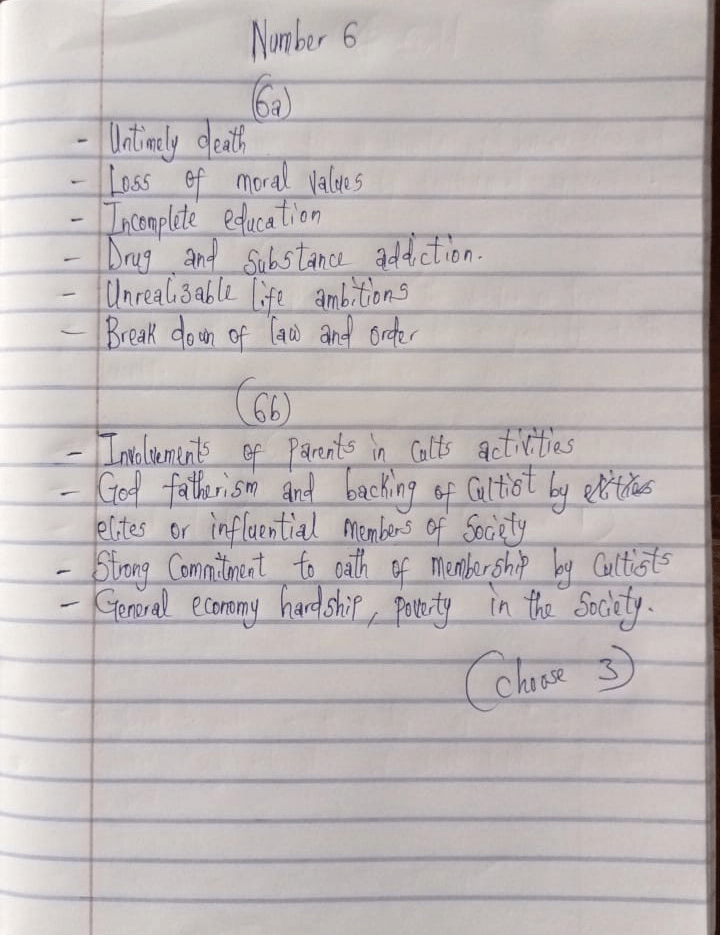
6(a) Six consequences of cultism in society are:
1. Violence and Crime: Cultism is often associated with violence, intimidation, and criminal activities. Cult groups engage in various forms of violence, including physical assault, extortion, kidnapping, and even murder. This not only poses a threat to the safety and security of individuals but also disrupts societal harmony.
2. Social Disruption: Cultism can disrupt social order and cohesion within communities. It creates fear and tension among residents, leading to a breakdown of trust and cooperation. Cult activities can also disrupt academic environments, as they often target schools and campuses.
3. Loss of Lives and Potential: Cult-related violence and conflicts result in the loss of lives and potential. Young people who become involved in cultism may lose their lives prematurely or face imprisonment, denying them the opportunity to contribute positively to society.
4. Drug Abuse and Addiction: Cult groups are known to engage in drug abuse and trafficking. The lure of power and protection associated with cultism often leads members to indulge in substance abuse. This not only poses health risks to individuals but also fuels the drug trade, contributing to societal problems.
5. Recruitment of Youth: Cult groups often target vulnerable youth who may be seeking a sense of belonging, protection, or social identity. The recruitment of young people into cults can disrupt their education, values, and aspirations, trapping them in a cycle of violence and criminal activities.
6. Economic Implications: Cult activities can have negative economic consequences for communities. Businesses may suffer due to extortion and intimidation by cult members, and investment and development projects may be discouraged in areas where cultism is prevalent.
7
PICK FIVE
1. Advise the President in the performance of his/her functions under Article 172 of the Constitution.
2. Appoint, confirm in appointments, promote and exercise disciplinary control over persons holding office of the Public Service under Article 172 of the Constitution.
3. Appoint, Permanent Secretaries under Article 174 (2).
4. Appoint Clerk to Parliament under Article 87.
5. Appoint Secretary to Cabinet under Article 111(3)
6. Appoint Director of Public Prosecutions under Article 120(1)
7. Appoint Secretary and other staff of the Uganda Human Rights Commission under Article 57 of the Constitution.
8. Appoint Secretary and other staff of the Electoral Commission under Article 65 of the Constitution.
9. Review Terms and Conditions of Service, Standing Orders, qualifications of Public Officers, matters connected with Personnel Management and development of the Public Service and make recommendations on them to government.
10. Guiding and coordinating the work of the District Service Commission under Article 166 (1) of the Constitution.

WhatsApp :- 08167972482
 BEST EXAM PORTAL 1